
-
industrier
-
Allmän tillverkning
-
Avfallshantering
-
Förtillverkad
-
Kraft
-
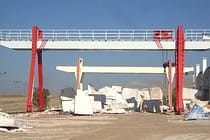
Sten
-
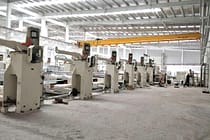
Papperstillverkning
-
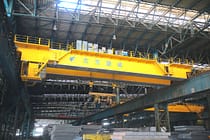
Metallproduktion
-
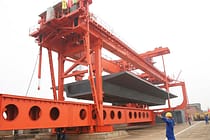
Brokonstruktion
-
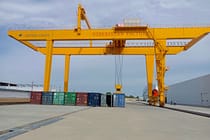
Hamnkranar: För container- och bulkhantering
-
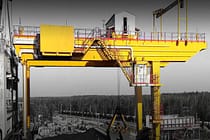
Traverskranar för olje- och gasindustrin: Förbättra driftseffektiviteten
-
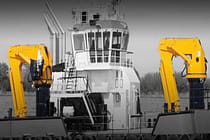
Marina kranar för effektiv lastning på fartyg
-
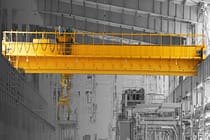
Traverskranar för fordonsindustrin: Effektiva automationslösningar
-
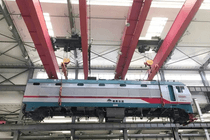
Traverskranlösningar för järnvägar: Spårläggning, underhåll av rullande materiel och containerhantering
-
Traverskranar för livsmedel och drycker: Tillförlitliga lösningar för effektiv hantering
-
Traverskranar för effektiv tillverkning av cement, glas, tegel och prefabricerad betong
-
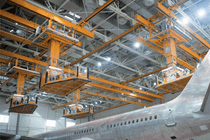
Traverskranar för flygindustrin: Flygplansunderhåll och montering
-
Traverskranar för flyg- och rymdfart: Precisionslyft för raketuppskjutning och transport
-
-
Produkter
-
Luftkranar
-
Enbalks traverskranar
-
Dubbelbalk överheadkranar
-
Traverskranar av europeisk typ med en balk
-
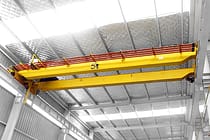
Europeiska dubbelbalkskranar
-
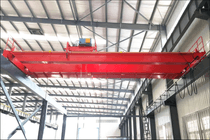
Explosionssäkra luftkranar
-
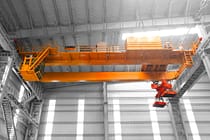
Grab och Magnetiska Overhead Kranar
-
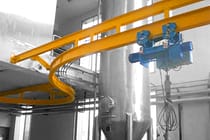
Monorail kranar
-
Gjuteri kranar
-
Isolering traverser
-
Låg takhöjd traverskranar
-
Ta tag i luftkranar
-
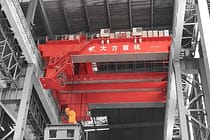
Slev traverskranar
-
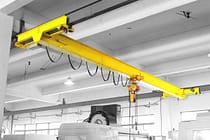
Underhängda traverskranar
-
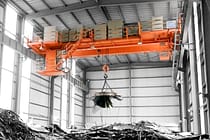
Elektromagnetiska traverskranar
-
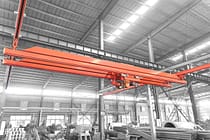
Arbetsstationskranar
-
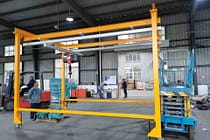
Fristående arbetsstationsbrokranar
-
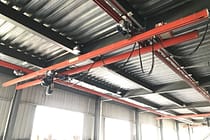
Takmonterad brokran
-
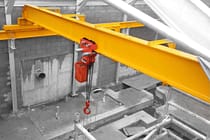
Manuella traverskranar
-
-
Gantry kranar
-
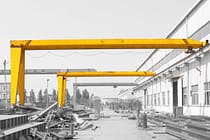
Semi portalkranar
-
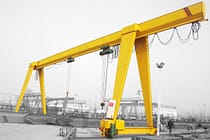
Enkelbalks portalkranar
-
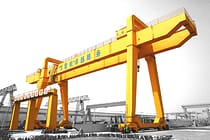
Dubbelbalk portalkranar
-
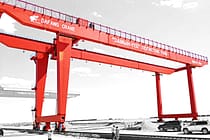
Container portalkranar
-
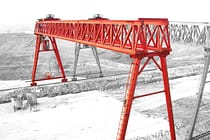
Truss portalkranar
-
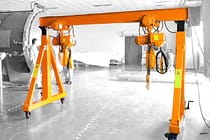
Justerbara portalkranar
-
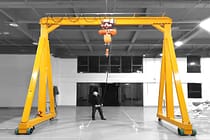
Bärbara portalkranar
-
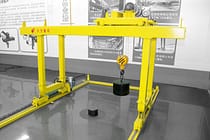
Europeiska portalkranar
-
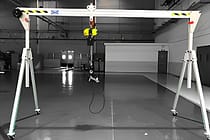
Portalkranar i aluminium
-
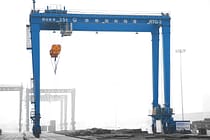
Gummi däckade container portalkranar
-
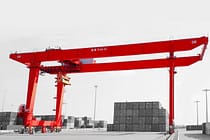
Rälsmonterade containerportalkranar
-
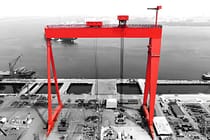
Shipyard Gantry Crane
-
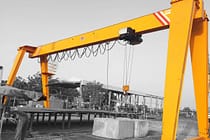
Europeiska portalkranar med en balk
-
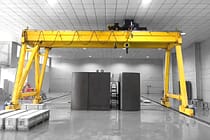
Europeiska portalkranar med dubbla balkar
-
- Fockkranar
- Specialkranar
- Elektriska lyftar
- Transfervagnar
-
Luftkranar
-
Kran delar
-
Ta tag i hinkar
-
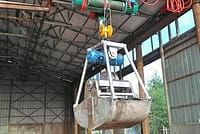
Elektrisk gripskopa i rostfritt stål
-
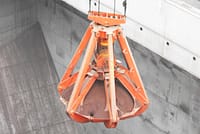
Mekaniska fyra rep av apelsinskal
-
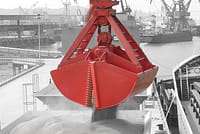
Mekanisk gripskopa med fyra rep
-
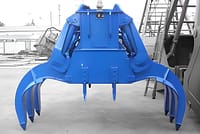
Elektrohydrauliska rektangulära grepp
-
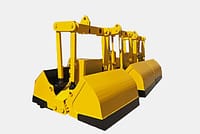
Elektrohydrauliska Clamshell-grepp
-
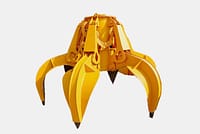
Elektrohydrauliska apelsinskalgrepp, hydrauliska kaktusgrepp
-
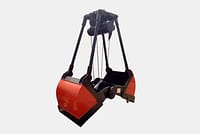
Elmotorgrepp
-
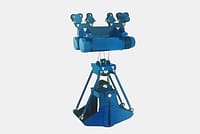
Elektrisk Monorail gripskopa med Monorail-lyft
-
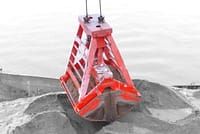
Fjärrkontroll Clamshell Grip
-
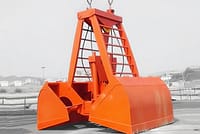
Mekaniska grepp med två rep
-
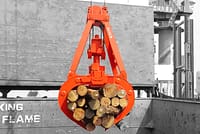
Timmergriper
-
Enkeltrep
-
Rengöringsmaskiner för papperskorgen
-
Muddringsgrepp
-
Trimningsgrepp
-
- Kranspridare
- Kran reservdelar
- Kranhjul
-
Ta tag i hinkar
- Företag
- Kontakt
-
industrier
-
Allmän tillverkning
-
Avfallshantering
-
Förtillverkad
-
Kraft
-
Sten
-
Papperstillverkning
-
Metallproduktion
-
Brokonstruktion
-
Hamnkranar: För container- och bulkhantering
-
Traverskranar för olje- och gasindustrin: Förbättra driftseffektiviteten
-
Marina kranar för effektiv lastning på fartyg
-
Traverskranar för fordonsindustrin: Effektiva automationslösningar
-
Traverskranlösningar för järnvägar: Spårläggning, underhåll av rullande materiel och containerhantering
-
Traverskranar för livsmedel och drycker: Tillförlitliga lösningar för effektiv hantering
-
Traverskranar för effektiv tillverkning av cement, glas, tegel och prefabricerad betong
-
Traverskranar för flygindustrin: Flygplansunderhåll och montering
-
Traverskranar för flyg- och rymdfart: Precisionslyft för raketuppskjutning och transport
-
-
Produkter
-
Luftkranar
-
Enbalks traverskranar
-
Dubbelbalk överheadkranar
-
Traverskranar av europeisk typ med en balk
-
Europeiska dubbelbalkskranar
-
Explosionssäkra luftkranar
-
Grab och Magnetiska Overhead Kranar
-
Monorail kranar
-
Gjuteri kranar
-
Isolering traverser
-
Låg takhöjd traverskranar
-
Ta tag i luftkranar
-
Slev traverskranar
-
Underhängda traverskranar
-
Elektromagnetiska traverskranar
-
Arbetsstationskranar
-
Fristående arbetsstationsbrokranar
-
Takmonterad brokran
-
Manuella traverskranar
-
-
Gantry kranar
-
Semi portalkranar
-
Enkelbalks portalkranar
-
Dubbelbalk portalkranar
-
Container portalkranar
-
Truss portalkranar
-
Justerbara portalkranar
-
Bärbara portalkranar
-
Europeiska portalkranar
-
Portalkranar i aluminium
-
Gummi däckade container portalkranar
-
Rälsmonterade containerportalkranar
-
Shipyard Gantry Crane
-
Europeiska portalkranar med en balk
-
Europeiska portalkranar med dubbla balkar
-
- Fockkranar
- Specialkranar
- Elektriska lyftar
- Transfervagnar
-
Luftkranar
-
Kran delar
-
Ta tag i hinkar
-
Elektrisk gripskopa i rostfritt stål
-
Mekaniska fyra rep av apelsinskal
-
Mekanisk gripskopa med fyra rep
-
Elektrohydrauliska rektangulära grepp
-
Elektrohydrauliska Clamshell-grepp
-
Elektrohydrauliska apelsinskalgrepp, hydrauliska kaktusgrepp
-
Elmotorgrepp
-
Elektrisk Monorail gripskopa med Monorail-lyft
-
Fjärrkontroll Clamshell Grip
-
Mekaniska grepp med två rep
-
Timmergriper
-
Enkeltrep
-
Rengöringsmaskiner för papperskorgen
-
Muddringsgrepp
-
Trimningsgrepp
-
- Kranspridare
- Kran reservdelar
- Kranhjul
-
Ta tag i hinkar
- Företag
- Kontakt



Overhead Crane Hook Types and Safety Requirements
Innehållsförteckning
The overhead crane hook is one of the most widely used load-handling devices. It has a simple structure, is easy to manufacture, and can be used in many lifting applications.
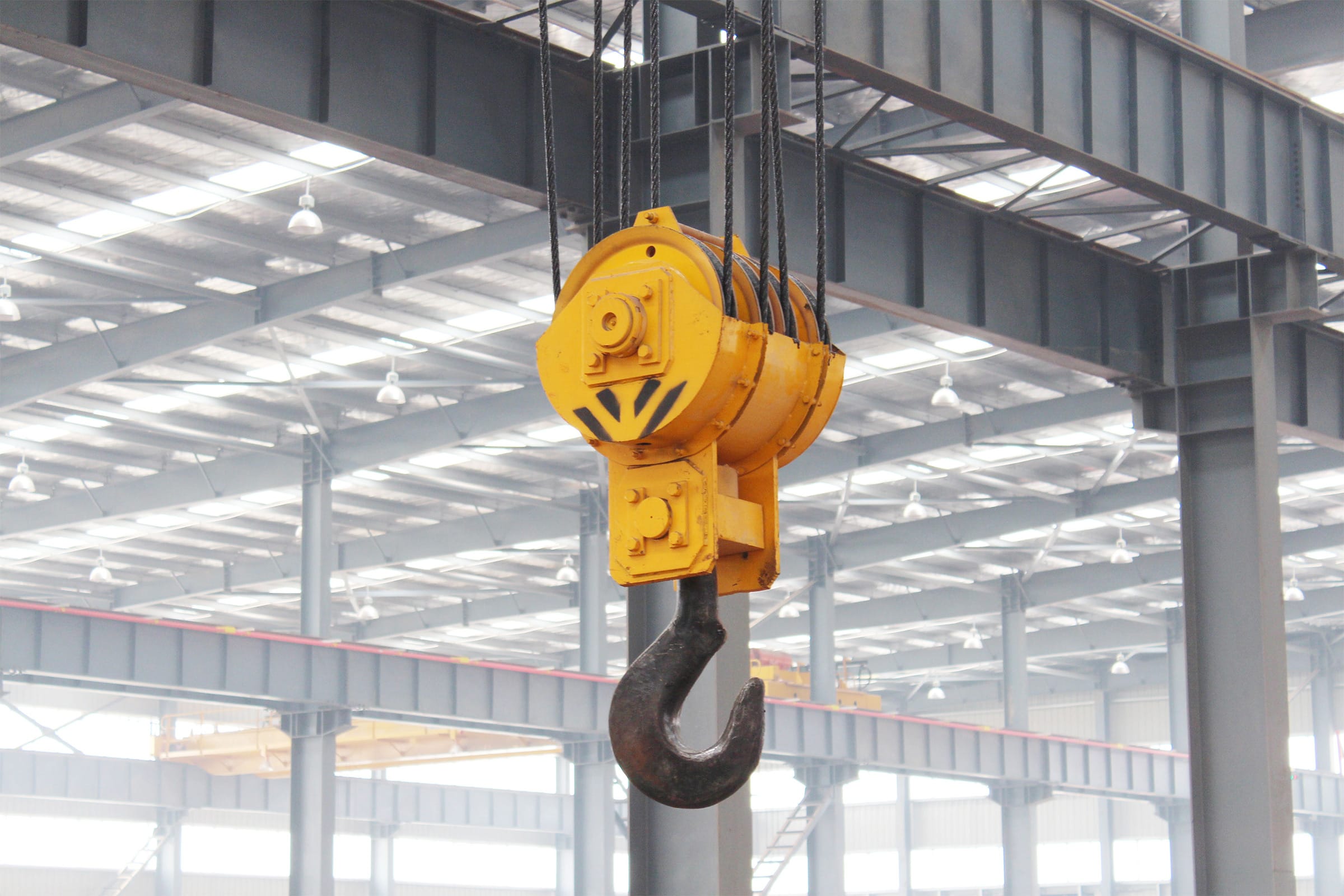
Overhead Crane Hook Types and Structure
According to the hook shape, overhead crane hooks can be divided into single hooks and double hooks. A single hook is easier to manufacture and use, while a double hook has a more favorable force condition. Single hooks are used for smaller lifting capacities. When the lifting capacity is large, double hooks are often used to avoid making the hook too heavy. For casting cranes, laminated single hooks are still used even for large lifting capacities because they must match the ladle.
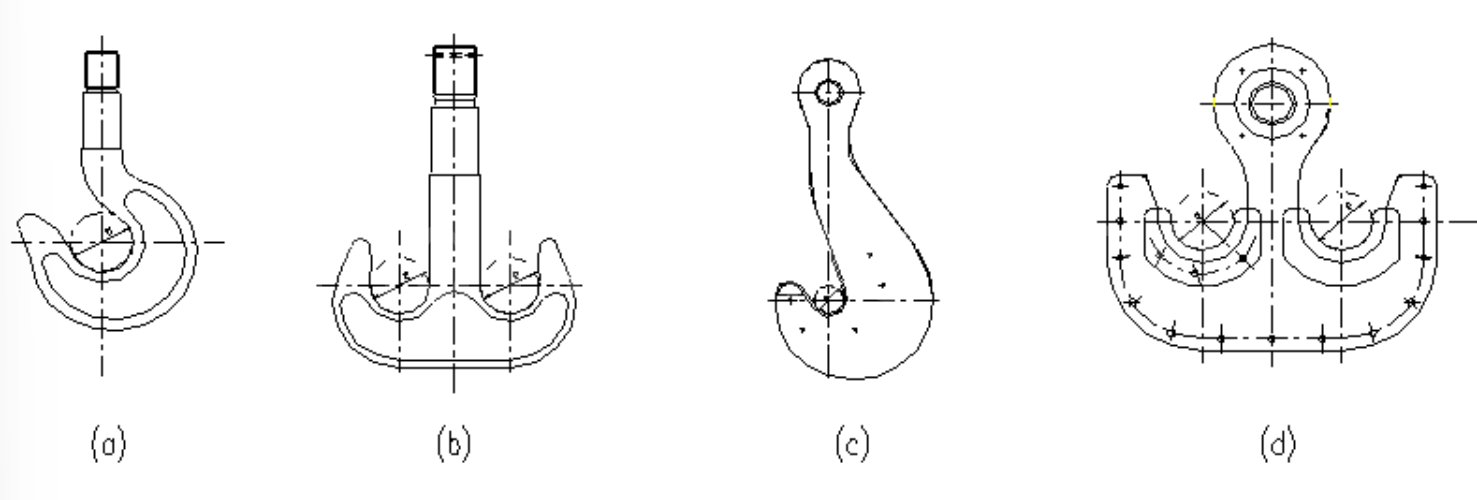
Forged hooks should be marked in a low-stress area with permanent marks that are not easy to wear off. The marks should include the rated lifting capacity, manufacturer’s mark, inspection mark, date, and serial number. After the forged hook manufacturer completes surface inspection and load testing, a certificate of conformity should be provided.
Laminated hooks are fastened by riveting each plate layer. After riveting, the front end and upper end of the hook plates should be welded. To prevent wear at the trunnion area, a metal wear-resistant plate should be installed on the upper side of the hook bend and should be easy to remove and install. A laminated hook is made by stacking several hook-shaped steel plates and connecting them with rivets.
To prevent accidental unhooking, the hook should be equipped with a safety device that prevents the load from slipping off.
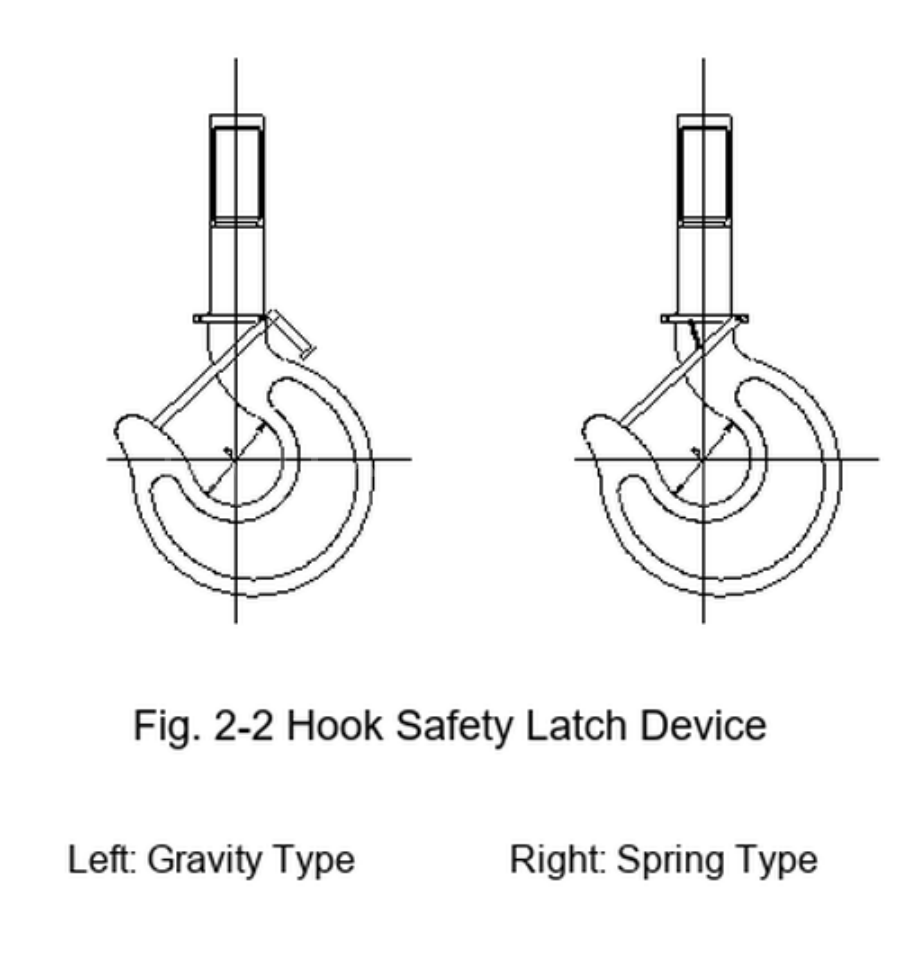
Overhead Crane Hook Blocks
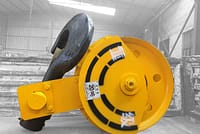
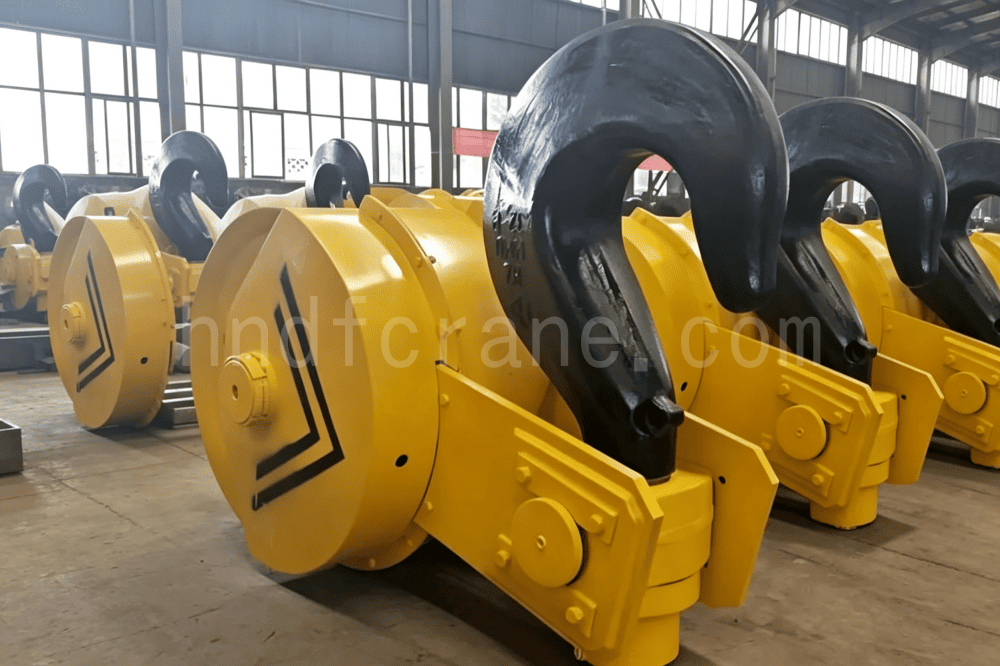
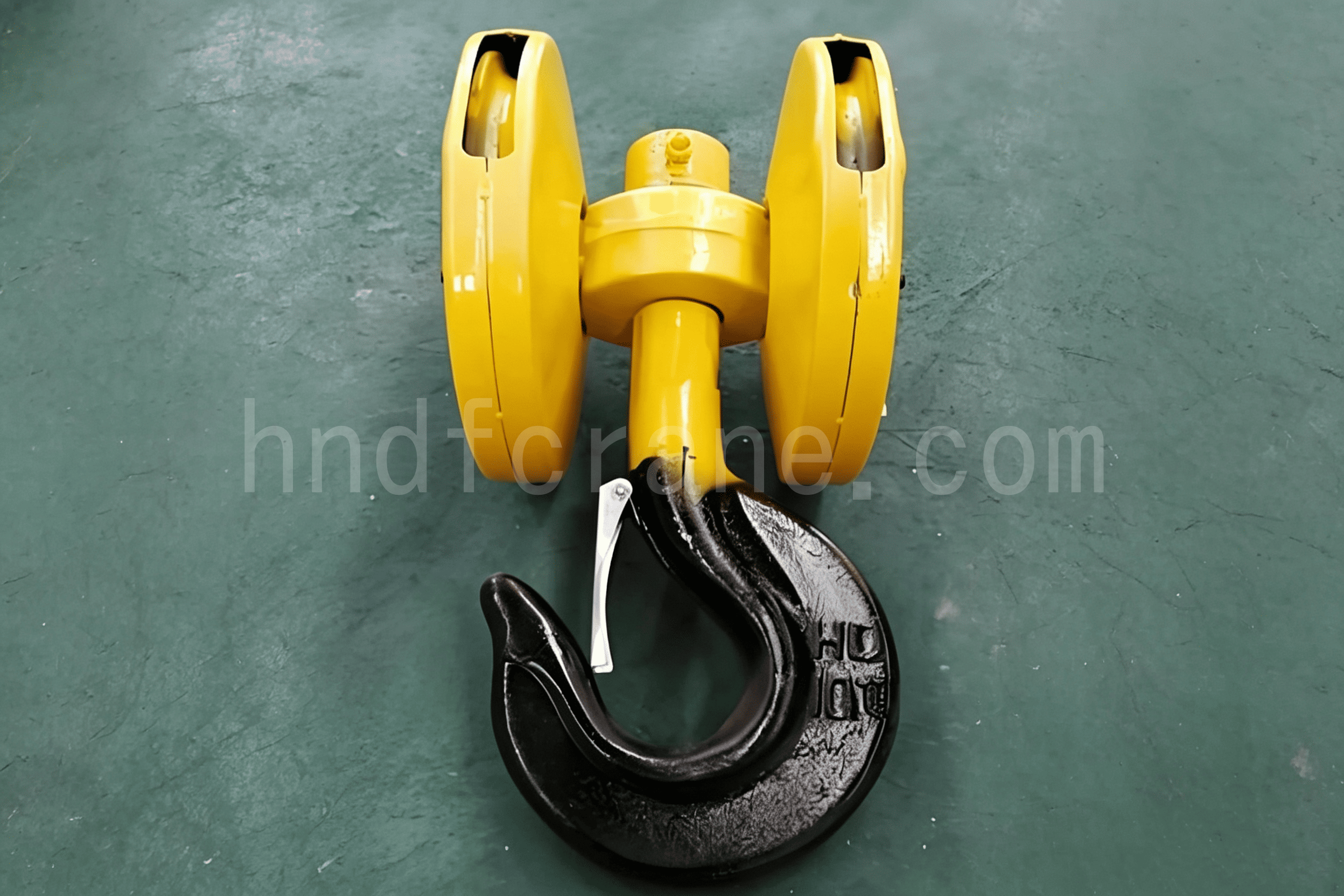
An overhead crane hook block is a combination of the hook and the moving pulley block. Hook blocks include ordinary hook blocks and electric rotating hook blocks. In a typical ordinary hook block, the hook can be manually pushed to rotate. When the hook is not allowed to rotate, a locking device can be added.
Ordinary hook blocks are available in long-type and short-type structures.
A long-type hook block uses an ordinary short hook with a short shank. The hook is supported on the hook crossbeam, while the sheaves are supported on a separate sheave shaft. This structure has a larger overall height and reduces the effective lifting height.
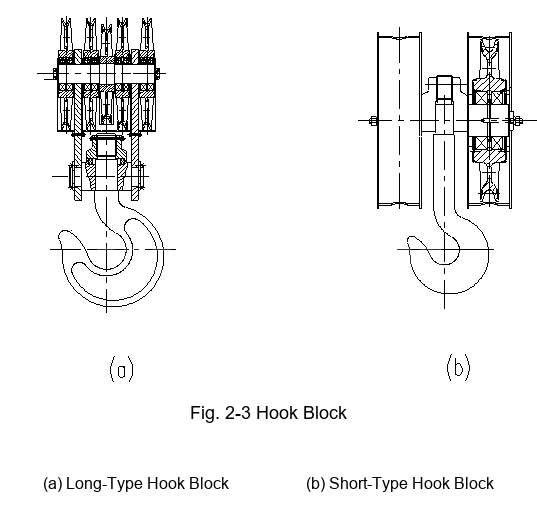
Short-type hook blocks used to use long hooks. In this structure, the sheaves are directly mounted on the hook crossbeam, greatly reducing the height. However, this structure can only be used for double-rope reeving. A short-type hook block is suitable only for smaller reeving ratios. When the reeving ratio is large, the number of sheaves increases, the hook crossbeam becomes too long, the bending moment becomes too large, and the hook’s own weight increases.
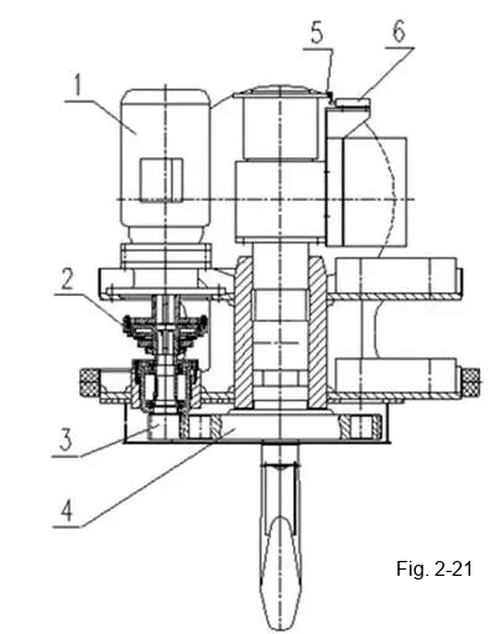
An electric rotating hook block is usually driven by a cycloidal pinwheel geared motor with braking function, marked as item 1 in Fig. 2-21. A three-in-one reducer may also be used. The motor drives gears 3 and 4 through friction coupling 2, causing the hook to rotate. When the hook reaches the specified position, cam switch plate 5 touches limit switch 6, the circuit is cut off, the brake motor brakes, and the hook stops at the set angle. An angle locking device may also be provided according to user requirements.
The rotation speed of an electric rotating hook is generally about 2 r/min, and the rotation angle is not more than 270 degrees.
Dangerous Sections of an Overhead Crane Hook
The dangerous sections of an overhead crane hook are important areas for daily inspection and safety inspection. Based on force analysis, the following dangerous sections can be identified.
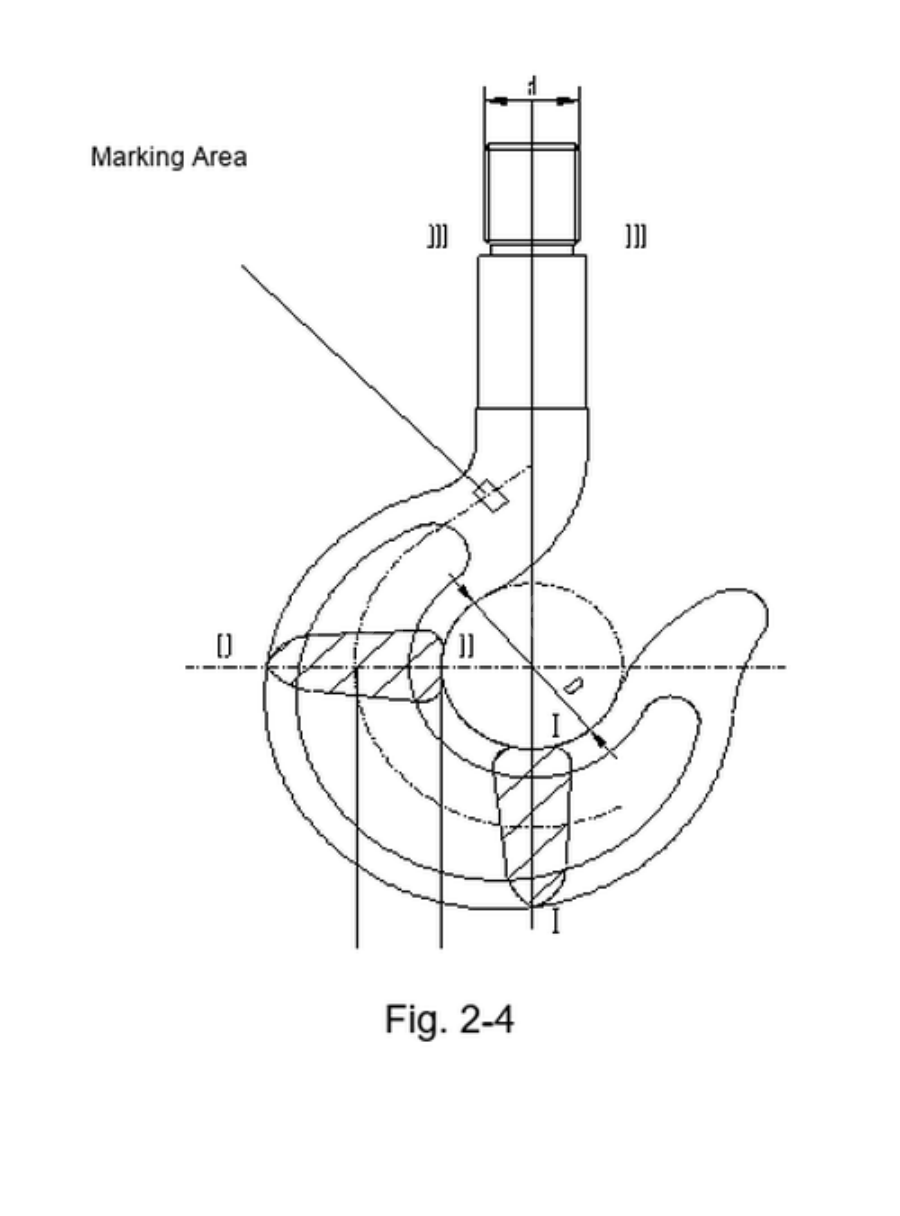
Assume that the weight suspended on the hook is Q.
- I – I: The load acts on section I-I of the hook through the wire rope, creating a tendency to shear the hook. This section is subjected to shear stress.
- III – III: Under the action of weight Q, this section tends to be pulled apart. It is located at the thread relief groove of the cylindrical shank of the hook. This is the smallest section of the hook and has a risk of tensile failure.
- II – II: The inner side is subjected to tensile stress, while the outer side is subjected to compressive stress. According to calculation, the tensile stress on the inner side is greater than the compressive stress on the outer side. Under the action of load Q, the hook is subjected to tensile and shear stress and also tends to be straightened. In the hook shown in Fig. 2-4, the sections to the right of the centerline are subjected not only to tension, but also to moment M.
Overhead Crane Hook Safety Inspection Requirements
Hooks are widely used in different types of lifting machinery. Some hooks are manufactured according to previously used industry standards, while others are manufactured according to GB10051.1-5, Lifting Hooks. During inspection and testing, the inspection items and content are generally the same for different hook types, but the specific requirements may differ slightly.
An overhead crane hook should be inspected once every six months and should be cleaned and lubricated to prevent fatigue cracks.
The general inspection method is to first clean the hook body with kerosene. Then use a 20x magnifying glass to check whether the hook body has fatigue cracks, especially at the dangerous sections. The thread relief groove of the hook shank is a stress concentration area and should be checked carefully for cracks. For a plate hook, the bushing, pins, small holes, lifting lugs, and other fasteners should also be checked for looseness and wear. For hooks used on some large cranes or heavy-duty-class cranes, nondestructive testing should also be used to check for internal defects.
Overhead Crane Hook Load Test
For a new hook, in addition to the technical certificate from the manufacturer, a load test should be carried out according to the marks on the hook. The hook can be used only after its performance is confirmed to be qualified. For a hook that has worn during service, progressive load testing should also be carried out to redetermine the allowable rated lifting capacity.
After the hook under inspection is loaded to the specified test load, the load should be lifted and suspended for 10 minutes. After unloading, there should be no defects or deformation. The hook surface should then be inspected with a 20x magnifying glass and should have no cracks. The hook opening should be measured, and the increase compared with the original value should not exceed 0.25%.
Overhead Crane Hook Scrap Criteria
A hook should be scrapped if any of the following conditions occur:
- Cracks appear on the surface.
- Wear at the dangerous section reaches 10% of the original dimension.
- The hook opening increases by 15% compared with the original dimension.
- Torsional deformation exceeds 10 degrees.
- Plastic deformation occurs at the dangerous section or hook neck.

Jag är Cindy, med 10 års arbetslivserfarenhet inom kranbranschen och samlat på mig en mängd professionell kunskap. Jag har valt de tillfredsställande kranarna för 500+ kunder. Om du har några behov eller frågor om kranar är du välkommen att kontakta mig, jag kommer att använda min expertis och praktiska erfarenhet för att hjälpa dig att lösa problemet!
Skicka din förfrågan
- E-post: sales@hndfcrane.com
- WhatsApp: +86 191 3738 6654
- Telegram: +86 191 3738 6654
- Tel: +86-373-581 8299
- Fax: +86-373-215 7000
- Lägg till: Changnao Industrial District, Xinxiang City, Henan-provinsen, Kina
 WeChat
- Luftkranar
- Dubbelbalk överheadkranar
- Enbalks traverskranar
- Traverskranar av europeisk typ med en balk
- Explosionssäkra luftkranar
- Grab och Magnetiska Overhead Kranar
- Monorail kranar
- Gjuteri kranar
- Arbetsstationskranar
- Fockkranar
- Väggmonterade kranar
- Väggfockkranar
- Fristående jibbkranar
- Aluminiumsvängkranar: Lätt, smidig roterande arm för enkel lyftning
- Balanssvängkranar: Effektiva lätta lyft för mekanisk montering över korta avstånd
- Manuella fristående svängkranar: Effektiva manuella lyftlösningar för operationer med begränsat utrymme
- Elektriska fristående svängkranar: Helelektrisk lösning för högkapacitets snabba lyft
- Ledsvängkranar: Precisionslyft med dubbelarmsflexibilitet
- Gantry kranar
- Dubbelbalk portalkranar
- Semi portalkranar
- Enkelbalks portalkranar
- Truss portalkranar
- Container portalkranar
- Justerbara portalkranar
- Bärbara portalkranar
- Europeiska portalkranar
- industrier
- Allmän tillverkning
- Avfallshantering
- Förtillverkad
- Kraft
- Sten
- Papperstillverkning
- Metallproduktion
- Brokonstruktion
- Hamnkranar: För container- och bulkhantering
- Traverskranar för olje- och gasindustrin: Förbättra driftseffektiviteten
- Marina kranar för effektiv lastning på fartyg
- Traverskranar för fordonsindustrin: Effektiva automationslösningar
- Elektriska lyftar
- Elektriska vajertelfer
- Elektriska kedjetelfer
- Elektriska lyftanordningar av europeisk typ
- Europeiska elektriska kedjetelfer: Jämn drift, lågt ljud och energieffektivitet
- Manuella lyftanordningar: Perfekta för drag- och lyftuppgifter
- Handkättingtelfrar: Manuell lyftning för områden utan ström
- Elektriska lyftanordningar med låg takhöjd: Kompakt design för maximal utrymmeseffektivitet
- Pneumatiska kedjetelfrar: Smidig hantering för industriellt bruk
- Explosionssäkra manuella kättingtelfrar: Gnistsäker kopparlegeringskonstruktion för explosionsfarliga områden
- Explosionssäkra elektriska kättingtelfrar för lyft i farliga områden
- Handla om
- Fall
- Nyheter
- Vanliga frågor
- Ladda ner
- Bloggar
- Onlineverktyg för beräkning av kranhjulslast
- VR Panorama
- Kontakta oss
- E-post: sales@hndfcrane.com
- WhatsApp: +86 191 3738 6654
- Telegram: +86 191 3738 6654
- Tel: +86-373-581 8299
-