
-
Industries
-
General Manufacturing
-
Waste Handling
-
Precast
-
Power
-
Stone
-
Papermaking
-
Metal Production
-
Bridge Construction
-
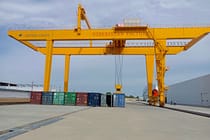
Port Cranes: For Container and Bulk Material Handling
-
Overhead Cranes for Petroleum and Gas Industry: Enhance Operational Efficiency
-
Marine Cranes for Efficient Cargo Loading on Ships
-
Overhead Cranes for the Automotive Industry: Efficient Automation Solutions
-
Overhead Crane Solutions for Railways: Track Laying, Rolling Stock Maintenance, and Container Handling
-
Overhead Cranes for Food and Beverages: Reliable Solutions for Efficient Handling
-
Overhead Cranes for Efficient Cement, Glass, Brick and Precast Concrete Manufacturing
-
Overhead Cranes for Aviation Industry: Aircraft Maintenance and Assembly
-
Aerospace Overhead Cranes: Precision Lifting for Rocket Launch and Transport
-
-
Products
-
Overhead Cranes
-
Single Girder Overhead Cranes
-
Double Girder Overhead Cranes
-
European Type Single Girder Overhead Cranes
-
European Type Double Girder Overhead Cranes
-
Explosion Proof Overhead Cranes
-
Grab And Magnetic Overhead Cranes
-
Monorail Cranes
-
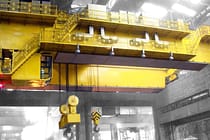
Foundry Overhead Cranes
-
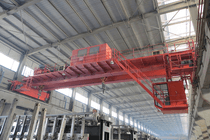
Insulation Overhead Cranes
-
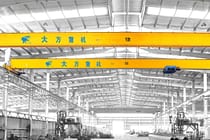
Low Headroom Overhead Cranes
-
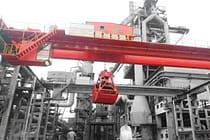
Grab Overhead Cranes
-
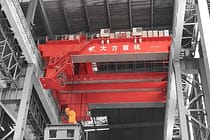
Ladle Overhead Cranes
-
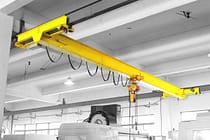
Underhung Overhead Cranes
-
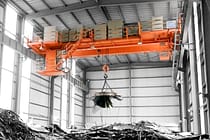
Electromagnetic Overhead Cranes
-
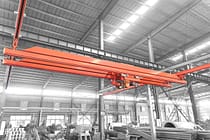
Workstation Cranes
-
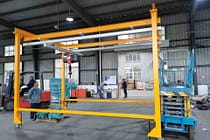
Free Standing Workstation Bridge Cranes
-
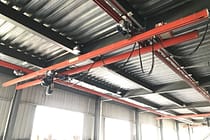
Ceiling Mounted Bridge Crane
-
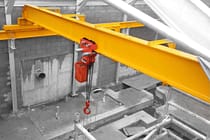
Manual Overhead Cranes
-
-
Gantry Cranes
-
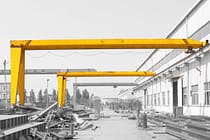
Semi Gantry Cranes
-
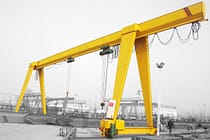
Single Girder Gantry Cranes
-
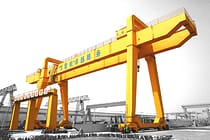
Double Girder Gantry Cranes
-
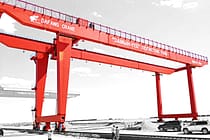
Container Gantry Cranes
-
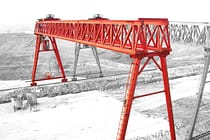
Truss Gantry Cranes
-
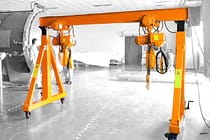
Adjustable Gantry Cranes
-
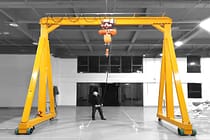
Portable Gantry Cranes
-
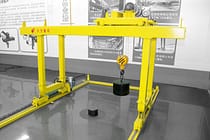
European Gantry Cranes
-
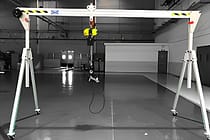
Aluminum Gantry Cranes
-
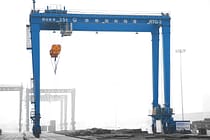
Rubber Tyred Container Gantry Cranes
-
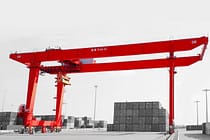
Rail Mounted Container Gantry Cranes
-
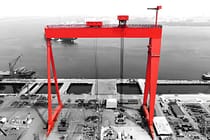
Shipyard Gantry Crane
-
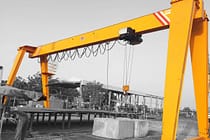
European Single Girder Gantry Cranes
-
European Double Girder Gantry Cranes
-
- Jib Cranes
- Special Cranes
- Electric Hoists
- Transfer Carts
-
Overhead Cranes
-
Crane Parts
-
Grab Buckets
-
Electric Stainless Steel Grab Bucket
-
Mechanical Four Rope Orange Peel Grabs
-
Mechanical Four Rope Clamshell Grabs Bucket
-
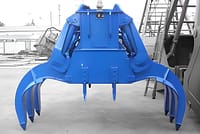
Electro Hydraulic Rectangular Grabs
-
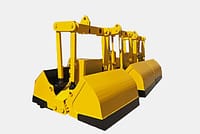
Electro hydraulic Clamshell Grabs
-
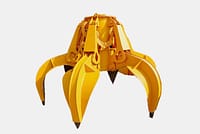
Electro Hydraulic Orange Peel Grabs,Hydraulic Cactus Grab
-
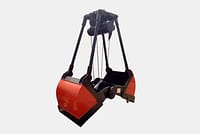
Electric Motor Grab
-
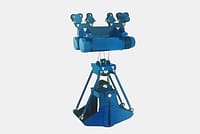
Electric Monorail Grab Bucket with Monorail Hoist
-
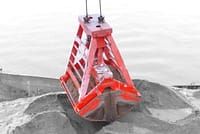
Remote Control Clamshell Grabs
-
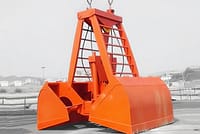
Mechanical Two Rope Clamshell Grabs
-
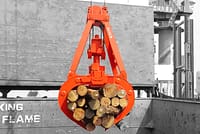
Timber Grabs
-
Single Rope Grab Bucket
-
Trash Rack Cleaning Machines
-
Dredging Grabs
-
Trimming Grabs
-
- Crane Spreader
-
Crane Spare Parts
-
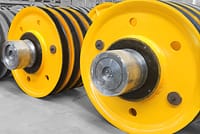
Crane Sheaves
-
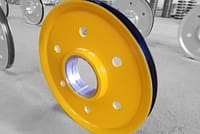
Wire Rope Sheaves
-
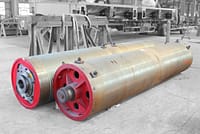
Crane Rope Drum
-
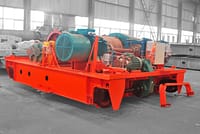
Crane Trolley
-
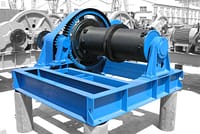
Electric Winch
-
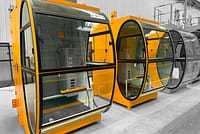
Crane Operator Cabin
-
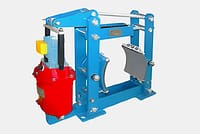
Overhead Crane Brakes
-
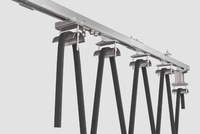
Overhead Crane Cables
-
Overhead Crane Rope Guides
-
Overhead Crane Conductors and Power Supply Lines
-
Overhead Crane Rails
-
Overhead Crane Rail Clips
-
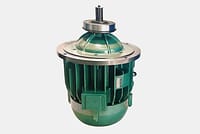
Overhead Crane Motors
-
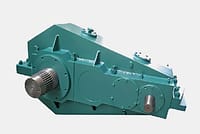
Overhead Crane Reducers
-
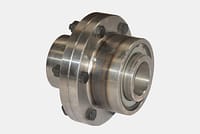
Couplings for Overhead Crane
-
- Crane Wheels
-
Grab Buckets
- Company
- Contact

-
Industries
-
General Manufacturing
-
Waste Handling
-
Precast
-
Power
-
Stone
-
Papermaking
-
Metal Production
-
Bridge Construction
-
Port Cranes: For Container and Bulk Material Handling
-
Overhead Cranes for Petroleum and Gas Industry: Enhance Operational Efficiency
-
Marine Cranes for Efficient Cargo Loading on Ships
-
Overhead Cranes for the Automotive Industry: Efficient Automation Solutions
-
Overhead Crane Solutions for Railways: Track Laying, Rolling Stock Maintenance, and Container Handling
-
Overhead Cranes for Food and Beverages: Reliable Solutions for Efficient Handling
-
Overhead Cranes for Efficient Cement, Glass, Brick and Precast Concrete Manufacturing
-
Overhead Cranes for Aviation Industry: Aircraft Maintenance and Assembly
-
Aerospace Overhead Cranes: Precision Lifting for Rocket Launch and Transport
-
-
Products
-
Overhead Cranes
-
Single Girder Overhead Cranes
-
Double Girder Overhead Cranes
-
European Type Single Girder Overhead Cranes
-
European Type Double Girder Overhead Cranes
-
Explosion Proof Overhead Cranes
-
Grab And Magnetic Overhead Cranes
-
Monorail Cranes
-
Foundry Overhead Cranes
-
Insulation Overhead Cranes
-
Low Headroom Overhead Cranes
-
Grab Overhead Cranes
-
Ladle Overhead Cranes
-
Underhung Overhead Cranes
-
Electromagnetic Overhead Cranes
-
Workstation Cranes
-
Free Standing Workstation Bridge Cranes
-
Ceiling Mounted Bridge Crane
-
Manual Overhead Cranes
-
-
Gantry Cranes
-
Semi Gantry Cranes
-
Single Girder Gantry Cranes
-
Double Girder Gantry Cranes
-
Container Gantry Cranes
-
Truss Gantry Cranes
-
Adjustable Gantry Cranes
-
Portable Gantry Cranes
-
European Gantry Cranes
-
Aluminum Gantry Cranes
-
Rubber Tyred Container Gantry Cranes
-
Rail Mounted Container Gantry Cranes
-
Shipyard Gantry Crane
-
European Single Girder Gantry Cranes
-
European Double Girder Gantry Cranes
-
- Jib Cranes
- Special Cranes
- Electric Hoists
- Transfer Carts
-
Overhead Cranes
-
Crane Parts
-
Grab Buckets
-
Electric Stainless Steel Grab Bucket
-
Mechanical Four Rope Orange Peel Grabs
-
Mechanical Four Rope Clamshell Grabs Bucket
-
Electro Hydraulic Rectangular Grabs
-
Electro hydraulic Clamshell Grabs
-
Electro Hydraulic Orange Peel Grabs,Hydraulic Cactus Grab
-
Electric Motor Grab
-
Electric Monorail Grab Bucket with Monorail Hoist
-
Remote Control Clamshell Grabs
-
Mechanical Two Rope Clamshell Grabs
-
Timber Grabs
-
Single Rope Grab Bucket
-
Trash Rack Cleaning Machines
-
Dredging Grabs
-
Trimming Grabs
-
- Crane Spreader
-
Crane Spare Parts
-
Crane Sheaves
-
Wire Rope Sheaves
-
Crane Rope Drum
-
Crane Trolley
-
Electric Winch
-
Crane Operator Cabin
-
Overhead Crane Brakes
-
Overhead Crane Cables
-
Overhead Crane Rope Guides
-
Overhead Crane Conductors and Power Supply Lines
-
Overhead Crane Rails
-
Overhead Crane Rail Clips
-
Overhead Crane Motors
-
Overhead Crane Reducers
-
Couplings for Overhead Crane
-
- Crane Wheels
-
Grab Buckets
- Company
- Contact



Single Girder Overhead Crane VS Monorail Crane: 3 Key Differences to Help You Choose the Right Solution
Table of Contents
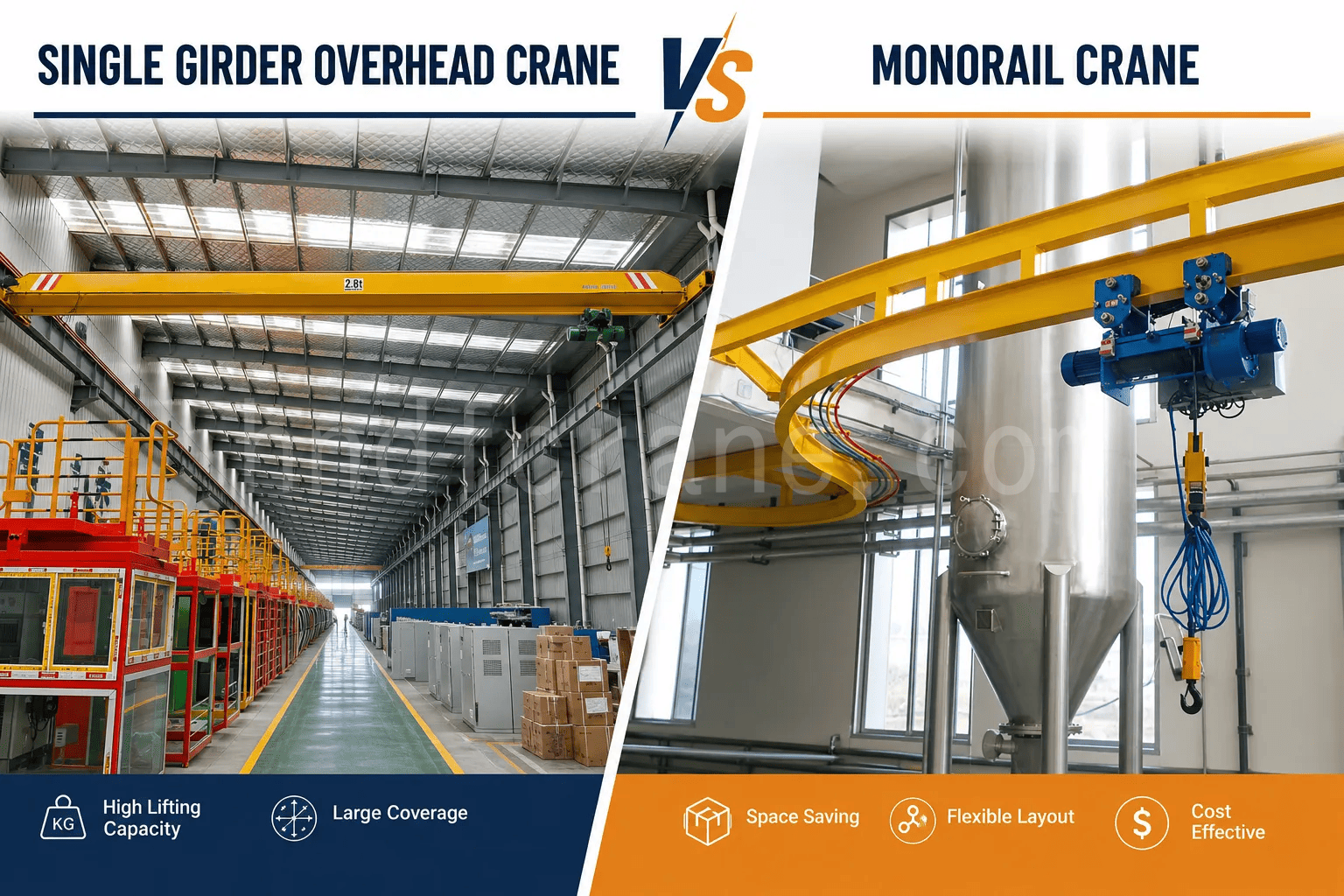
When planning a workshop lifting system, many procurement professionals face the same question: What is the difference between a single girder overhead crane and a monorail crane? From the outside, both can be installed above the workshop to handle material transportation, but in practical applications, their coverage areas and suitable scenarios are different.
This article will compare single girder overhead cranes and monorail cranes from aspects such as structural components, working areas, and basic parameters, helping you quickly determine which lifting equipment is more suitable for your project based on your workshop layout and operating conditions.
| Comparison Item | Single Girder Overhead Crane | Monorail Crane |
|---|---|---|
| Basic Structure | One main girder, two end trucks, crane traveling mechanism, and electric hoist | I-beam rail and electric hoist |
| Number of Rails | 2 rails (must be parallel and straight) | 1 rail (can include straight sections, curves, and branches) |
| Traveling Direction | The hoist moves horizontally along the main girder, and the crane moves longitudinally along the runway | The hoist moves along the monorail track |
| Working Area | Rectangular area | Linear path |
| Load Capacity | Usually below 10 tons, up to 20 tons | Usually below 5 tons, up to 10 tons |
| Operation Method | Pendant control / wireless remote control / operator cabin | Pendant control / wireless remote control |
| Suitable Applications | Lifting and handling materials at any position within a rectangular working area | Material transportation along a fixed route |
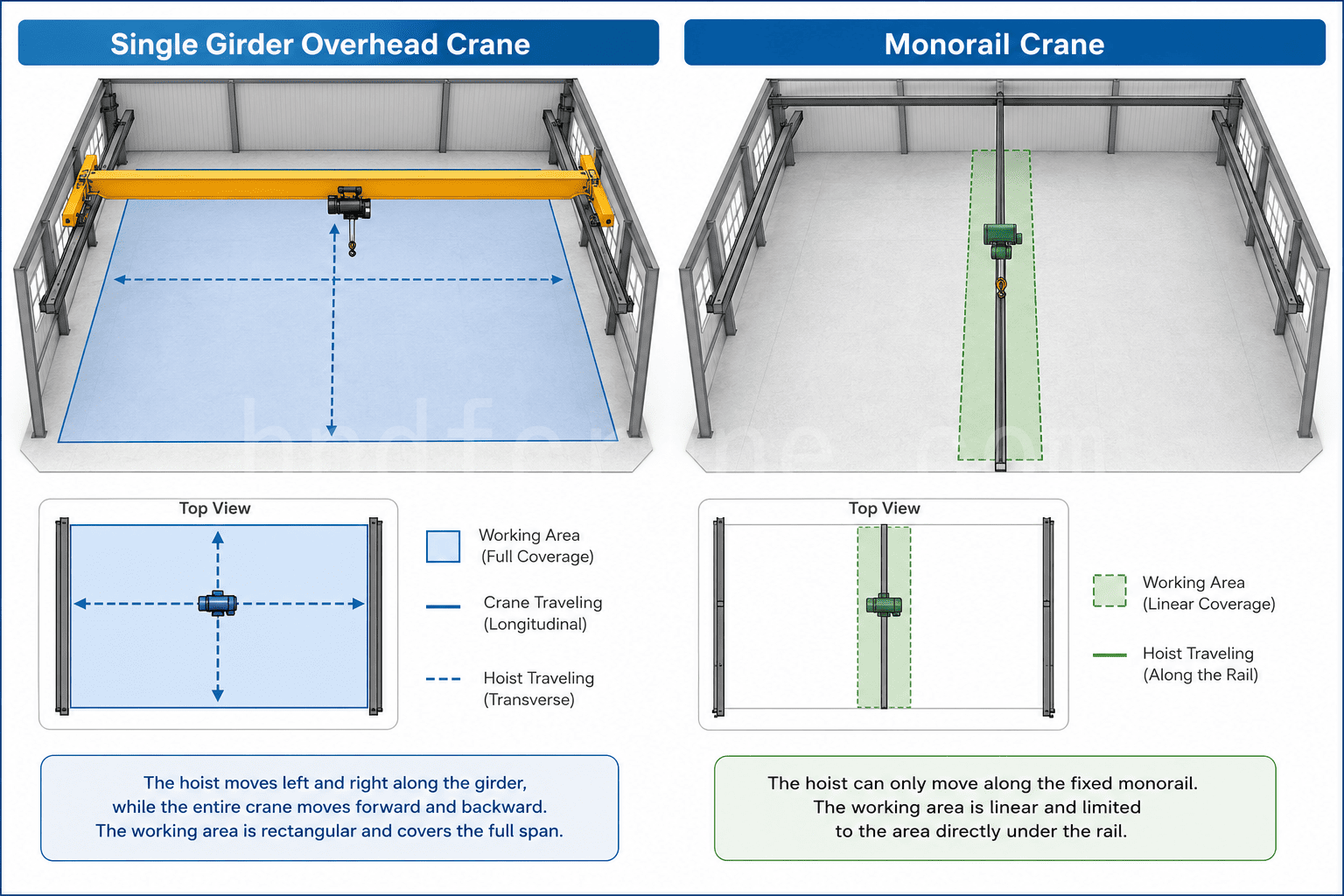
The fundamental difference between a single girder overhead crane and a monorail crane lies in the working area: the former covers a rectangular area, while the latter operates along a fixed track.
- If your workshop requires lifting and handling materials at any position across the entire span, choose a single girder overhead crane.
- If materials move along a fixed route and the lifting capacity does not exceed 5 tons, a monorail crane is usually more economical.
Structural Difference: Bridge Structure + Dual Rails vs Single Rail
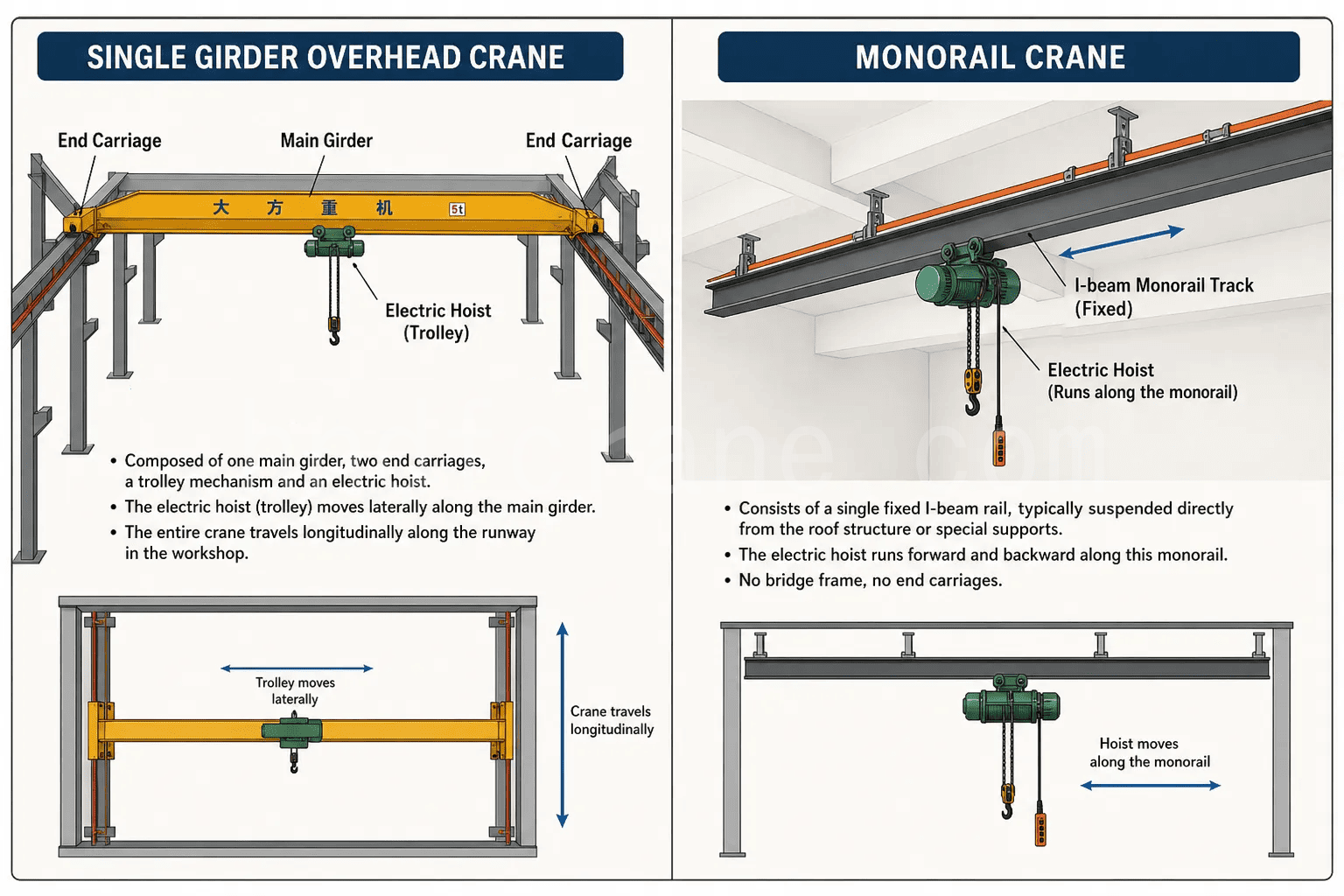
The most obvious difference between the two types of equipment is their structure.
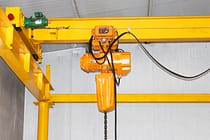
A single girder overhead crane consists of one main girder, two end trucks, a crane traveling mechanism, and an electric hoist. The main girder spans across the workshop, with both ends supported by end trucks running on two parallel rails. The crane is installed above the workshop columns (corbels) or dedicated supporting structures. The electric hoist is suspended below the main girder on an I-beam track, allowing it to move horizontally along the girder, while the entire crane moves longitudinally along the workshop.
The structure of a monorail crane is much simpler: it only requires one fixed I-beam rail, which is usually suspended directly below the roof structure or supported by dedicated brackets. The electric hoist travels back and forth along this single rail. There is no bridge structure and no end trucks.
Working Area: Rectangular Area vs Linear Path
If the working area of a single girder overhead crane is drawn, it forms a rectangle. The hoist moves horizontally along the main girder (trolley direction), while the entire crane moves longitudinally along the workshop (bridge traveling direction). These two movements intersect, covering any position within the entire span. For example, a single girder overhead crane with a 20-meter span and a 30-meter workshop length has a theoretical working area of 600 square meters.
The working area of a monorail crane is a line. The hoist can only move back and forth along the fixed I-beam rail, and the strip-shaped area beneath the rail represents its entire working range.
Advantage of Single Girder Overhead Crane: Access to Any Position
If your lifting starting and ending points are not fixed — for example, lifting materials from the storage area on the east side to a machine tool on the west side today, and from a welding station in the south to an assembly station in the north tomorrow — a monorail crane cannot handle such requirements.
A single girder overhead crane can position the main girder at any longitudinal location in the workshop, and the hoist can stop at any horizontal position along the girder. Combined together, these two movements enable lifting operations across the entire rectangular working area without dead zones.
Advantage of Monorail Crane: Ability to Follow Curved Routes
A commonly overlooked advantage of monorail cranes is that the track can be curved. I-beam rails can be processed into curved sections with a certain radius, and branch lines can also be added through track switches. A well-designed monorail system can connect multiple workstations: picking up materials from Station A, transporting them along the rail to Station B for processing, and then moving them to Station C for assembly.
This capability of “connecting multiple stations along a fixed route” is exactly what a single girder overhead crane cannot achieve. The two runway rails of an overhead crane must be arranged in parallel and in a straight line.
Load Capacity and Travel Length: Heavy-Duty Area Coverage vs Lightweight Linear Transportation
| Comparison Item | Single Girder Overhead Crane | Monorail Crane |
|---|---|---|
| Rated Load Capacity | 1–20 tons | 0.5–10 tons |
| Span / Track Length | 7.5–31.5 m (main girder span) | Can be extended by connecting track sections according to requirements |
| Duty Class | A3 | A3 |
| Lifting Speed | 8 m/min (single speed), 8/0.8 m/min (dual speed) | 8 m/min (single speed), 8/0.8 m/min (dual speed) |
| Trolley Travel Speed | 20–30 m/min | 20–30 m/min |
| Crane Travel Speed | 20–75 m/min | No crane traveling mechanism |
| Lifting Height | 6–30 m | 6–30 m |
The rated load capacity of a single girder overhead crane is usually 1–20 tons. With a bridge structure, the main girder is supported by end trucks on both sides, providing more balanced load distribution and allowing the crane to handle heavier loads. For applications involving loads above 10 tons, spans exceeding 20 meters, or frequent operation, a double girder overhead crane is usually recommended for further evaluation.
The standard rated load capacity of a monorail crane is generally 0.5–10 tons. However, since the rail itself is responsible for both supporting the load and guiding the movement, loads above 5 tons require larger rail sections and higher-strength supporting structures. Therefore, capacities within 5 tons are typically the more economical and widely used range for monorail systems.
In addition to load capacity, the two systems also differ significantly in travel length and application range. The main girder span of a single girder overhead crane is generally 7.5–31.5 meters, while the runway rails along the workshop length can be extended according to the building dimensions.
A monorail crane has no fixed span limitation. Its track can be freely connected and extended according to the production process, enabling continuous transportation over dozens of meters. However, the hoist can only travel along a single track, making it more suitable for fixed-route point-to-point transportation rather than full-area lifting coverage throughout the entire workshop.
Typical Applications of Both Equipment Types
Applications Suitable for Single Girder Overhead Cranes
Single girder overhead cranes are suitable for applications that require coverage of the entire workshop lifting area, allowing material handling at any position within the crane span and runway length.
They are particularly suitable for industries such as machinery manufacturing, steel structure fabrication, warehousing and logistics, and equipment assembly. They can be used for equipment lifting, raw material transfer, production line feeding, and finished product handling.
When a workshop requires frequent transportation of heavy loads across different areas, has a large lifting coverage requirement, and the lifting capacity is typically between 1 and 20 tons, a single girder overhead crane is an ideal choice that balances efficiency, coverage area, and investment cost.
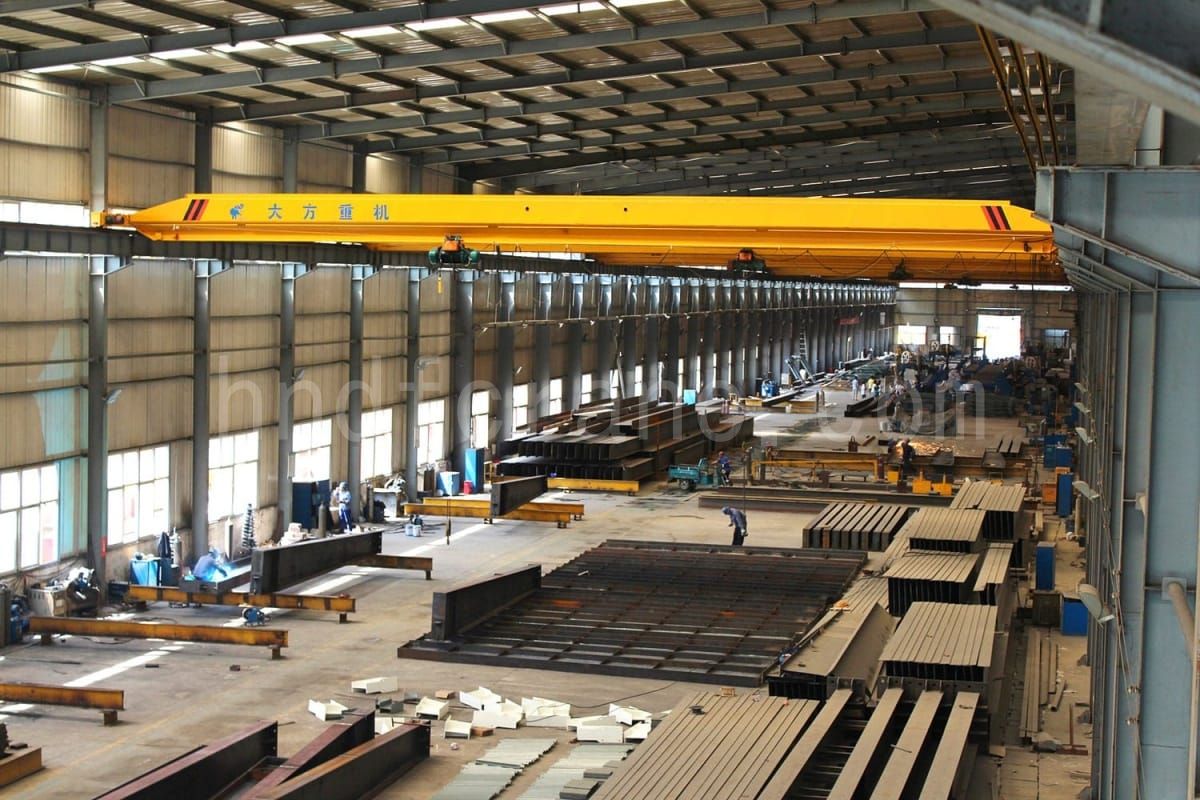
Raw material unloading upon arrival, loading and unloading of various machine tools, transfer of semi-finished products between different processes, and storage of finished products — the starting and ending points of material handling are not fixed. The full-span coverage capability of a single girder overhead crane ensures that materials can be lifted and transported to any position in the workshop at any time.
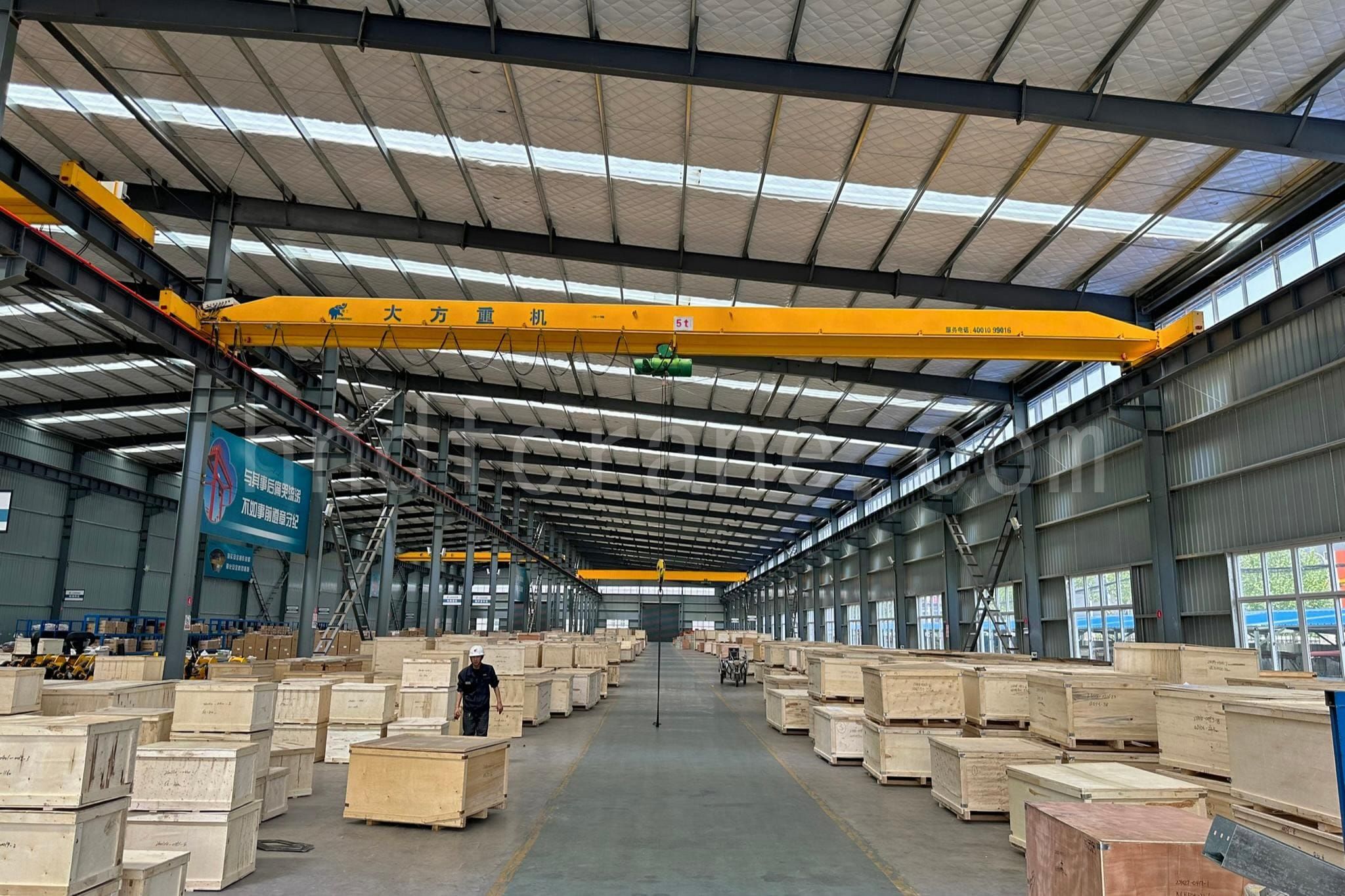
The storage locations and transportation destinations of goods in warehouses often change. A single girder overhead crane can move freely within the entire rectangular working area and accurately deliver goods to any storage location, making it more suitable for warehouse logistics operations involving multiple storage locations and multiple directions.
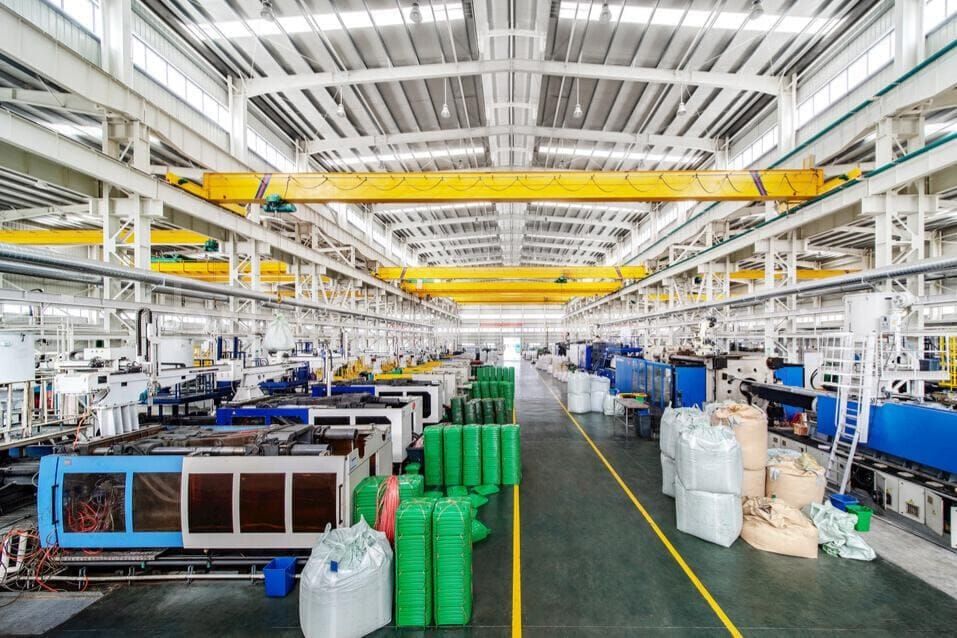
Injection molding workshops are usually equipped with multiple injection molding machines, and molds need to be frequently changed between different machines. A single girder overhead crane can cover the entire rectangular working area and directly transport molds to any injection molding machine.
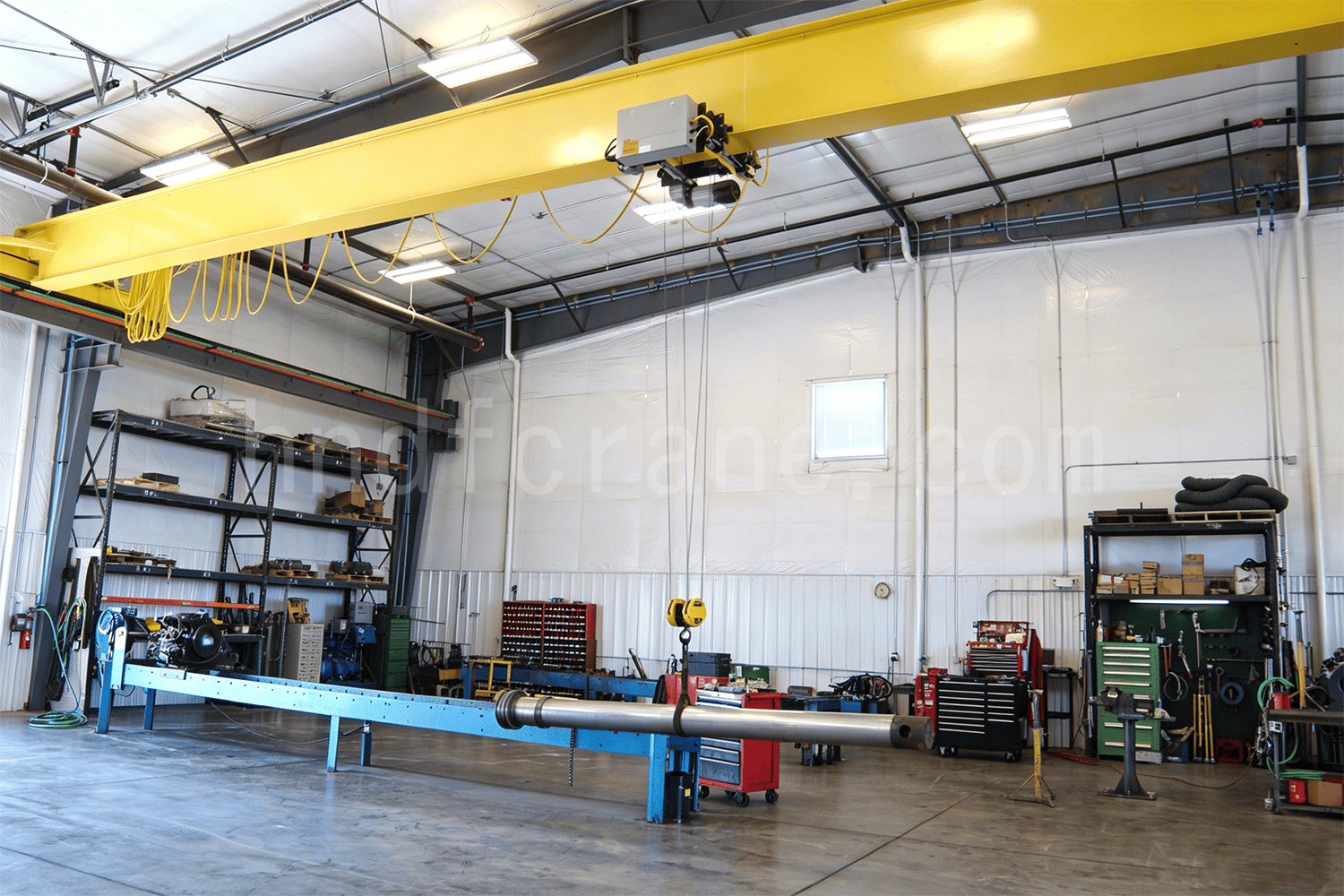
The lifting positions in maintenance workshops are usually not fixed, and different equipment requires disassembly and assembly at different workstations. A single girder overhead crane can cover the entire maintenance area and lift equipment or components to any maintenance workstation.
Applications Suitable for Monorail Cranes
Monorail cranes are ideal for applications with fixed material handling routes and linearly arranged lifting areas. The hoist can only travel along a predetermined track and cannot cover the entire workshop.
They are commonly used in painting lines, assembly lines, packaging lines, warehouse conveying systems, machine tool loading and unloading, and material transfer between production processes. They are particularly suitable for transporting workpieces from one workstation to the next following a fixed production flow. When the material handling path is clearly defined, full workshop coverage is unnecessary, and efficient use of building space is desired, a monorail crane provides an efficient and continuous material handling solution at a lower cost.
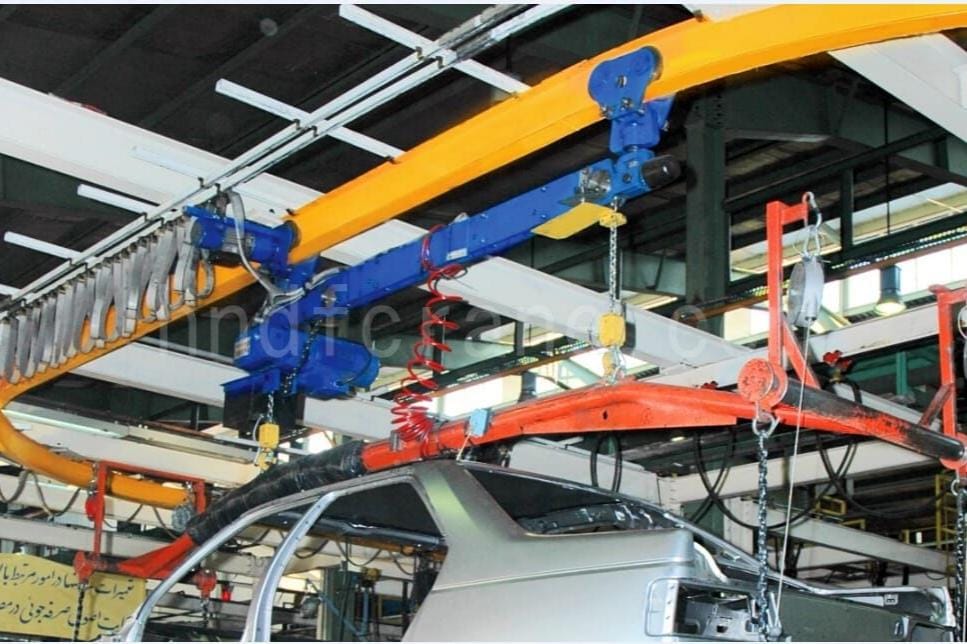
The automotive assembly process follows a well-defined production line layout, where workpieces move through multiple workstations in a fixed sequence. A monorail crane can travel continuously along a dedicated track, making it well suited for continuous production while offering excellent cost performance.
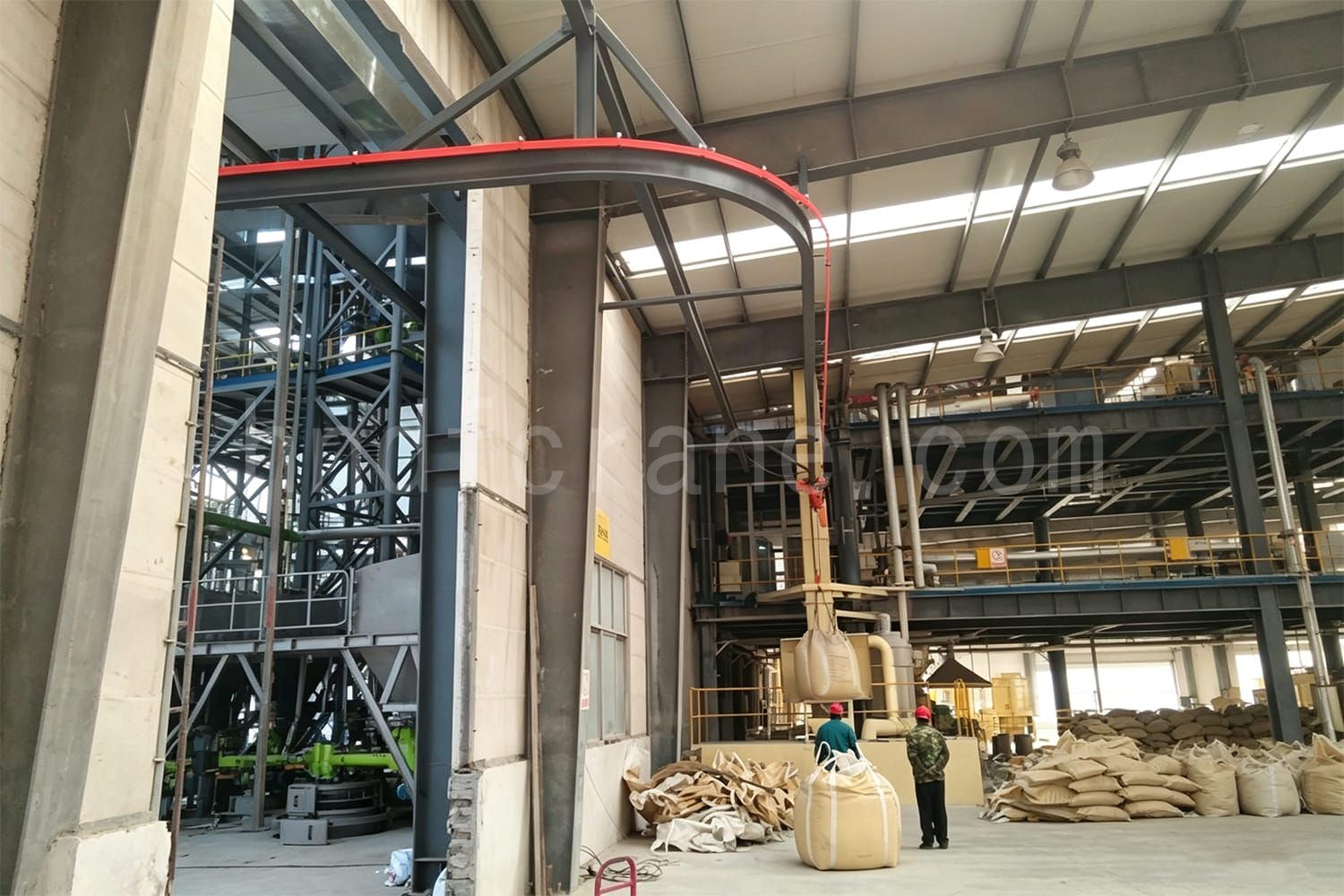
Material conveying lines typically have fixed transport routes and clearly defined loading and unloading points. A monorail crane can be designed with a dedicated track to match the production layout, ensuring stable and continuous material flow.
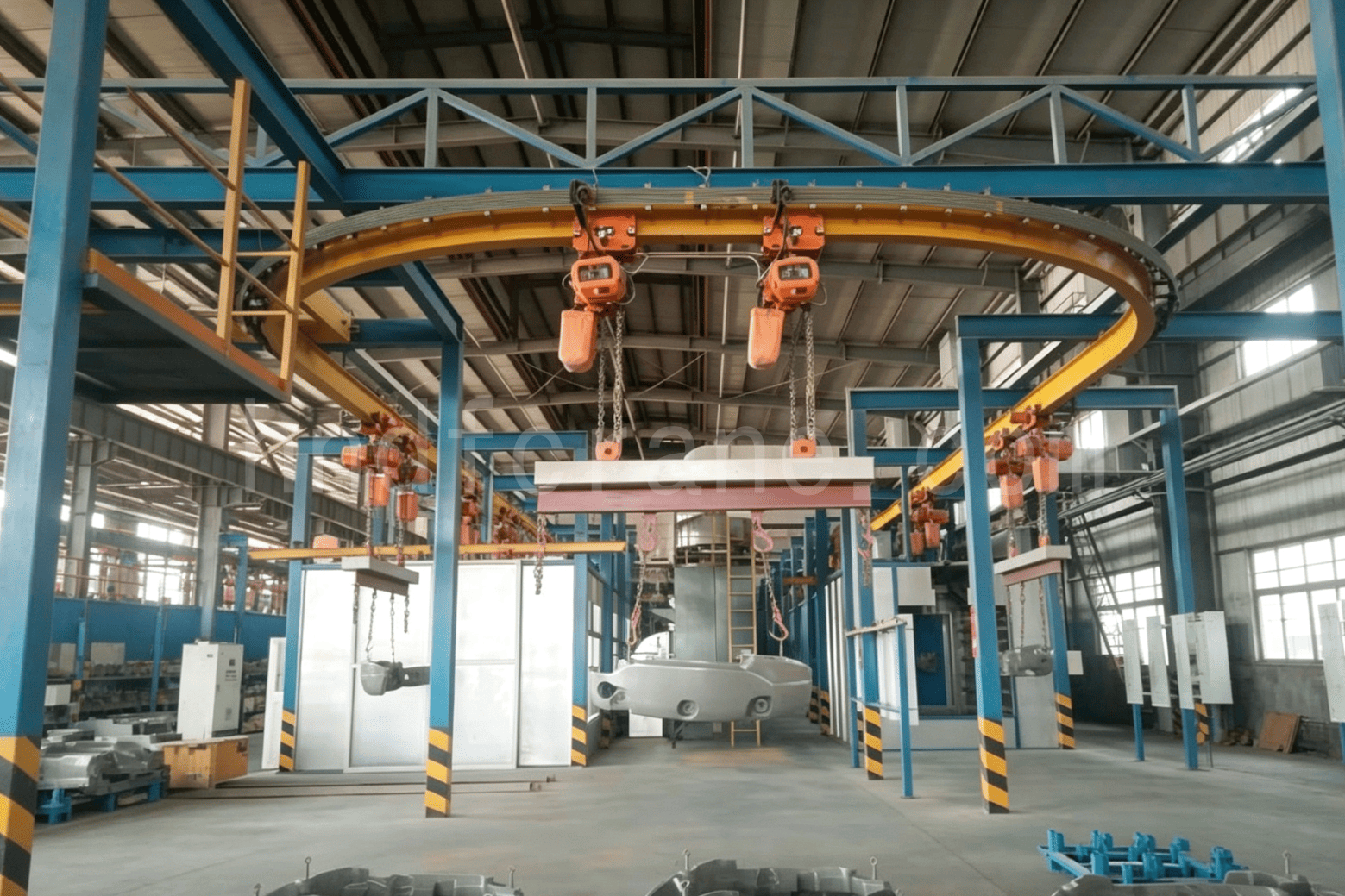
Painting lines usually require workpieces to move continuously along a fixed route while passing through multiple processing zones. A monorail crane can be designed with either a straight or looped track to match the plant layout, providing stable and continuous transportation.
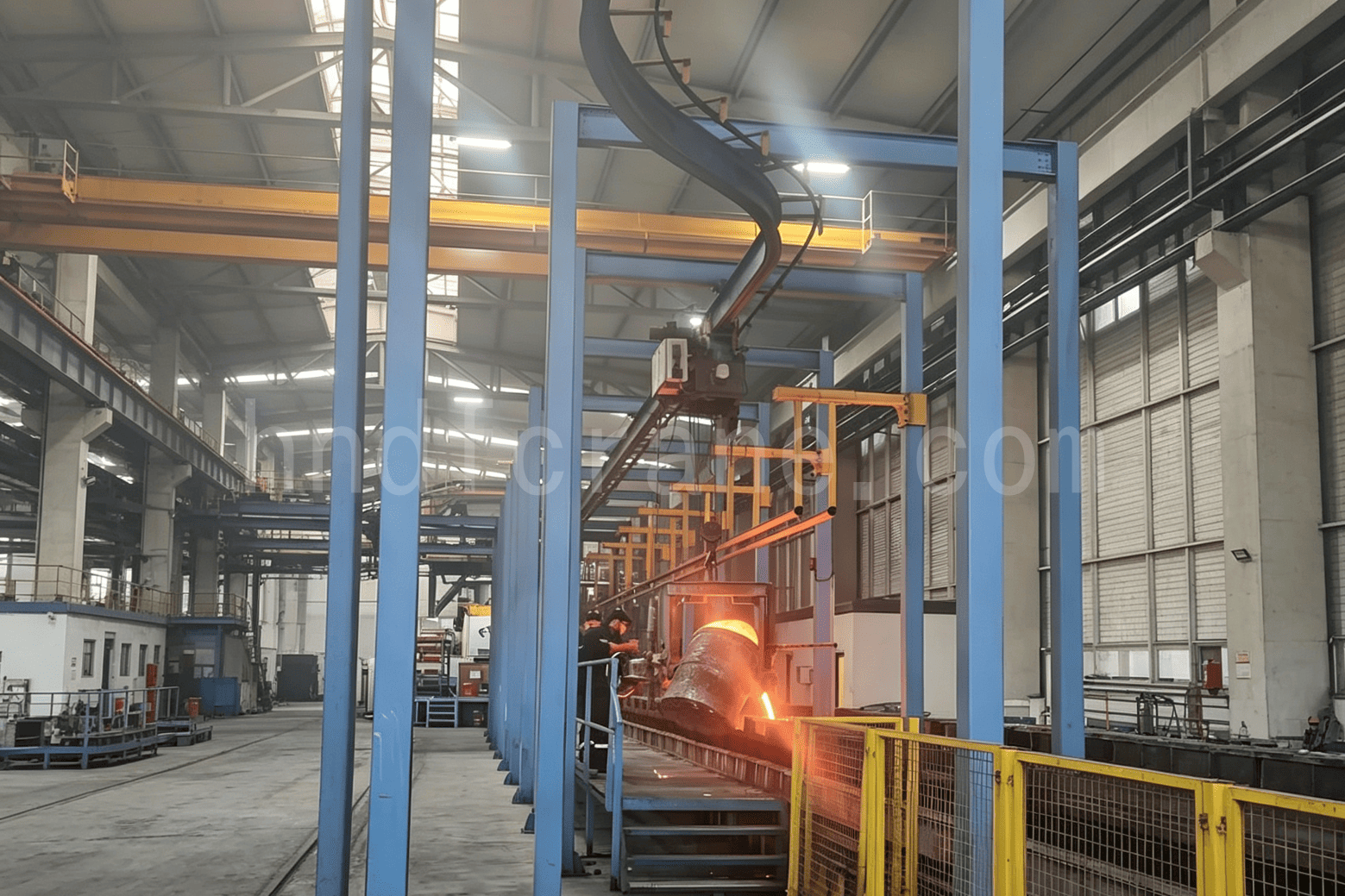
In foundry operations, ladles must be transported along the casting production line to move molten metal from the melting area to the pouring stations. A monorail crane can be configured with curved tracks to match the production line layout, enabling continuous material transport.
How to Choose Between a Single Girder Overhead Crane and a Monorail Crane?
If you’re still unsure after comparing the two crane types, follow these three simple steps to make the right choice.
Step 1: Map Out Your Material Handling Area
Start with your workshop layout and mark all loading and unloading points for material handling.
- If the lifting points are distributed throughout the workshop and require coverage of a rectangular working area, a single girder overhead crane is the better choice.
- If the lifting points are mainly located along a single production line or a fixed transport route, a monorail crane is usually the better option.
For most projects, the lifting area alone is enough to determine the most suitable crane type.
Step 2: Consider Your Typical Lifting Capacity
Choose based on the weight of the loads you handle most frequently.
- Frequently lifting more than 5 tons: A single girder overhead crane is generally recommended. For heavier loads, a double girder overhead crane may be a better solution.
- Mainly lifting 5 tons or less: Both crane types are suitable. The final decision should be based on the working area and material handling process.
It is worth noting that 5 tons is not a strict dividing line. Monorail cranes can also be designed for higher lifting capacities, but in practical applications they are more commonly used for small- to medium-capacity material handling along fixed routes.
Step 3: Think About Future Workshop Changes
In addition to your current production requirements, consider your plans for the next three to five years.
- If you expect to add new equipment, relocate workstations, or modify your production process, a single girder overhead crane offers greater flexibility. Its wider coverage usually eliminates the need to change the crane travel path when the workshop layout changes.
- If your production line is expected to remain unchanged and the material handling route will stay fixed, a monorail crane can meet your requirements with a simpler structure.
Get a Free Crane Selection Proposal and Quote
Both single girder overhead cranes and monorail cranes have their own advantages. There is no universally better option—the right choice depends on your lifting capacity, workshop layout, material handling route, operating frequency, and future expansion plans.
With nearly 20 years of industry experience, DAFANG CRANE provides lifting solutions tailored to your actual working conditions rather than simply recommending a particular product.
We can provide:
- Free crane selection recommendations based on your workshop drawings
- A comparison of different lifting solutions, including their advantages, limitations, and suitable applications
- CAD drawings and technical proposals
- Customized crane specifications based on your requirements
- A complete quotation and export shipping solution
Simply tell us your lifting capacity, span (or material handling route), lifting height, and workshop layout, and our engineers will recommend the most suitable lifting solution for your project within 24 hours, along with a free quotation.
Contact us today to get a customized lifting solution for your project.

I am Cindy, with 10 years of working experience in the crane industry and accumulated a wealth of professional knowledge. I have chosen the satisfying cranes for 500+ customers. If you have any needs or questions about cranes, please feel free to contact me, I will use my expertise and practical experience to help you solve the problem!
Send Your Inquiry
- Email: sales@hndfcrane.com
- WhatsApp: +86 191 3738 6654
- Telegram: +86 191 3738 6654
- Tel: +86-373-581 8299
- Fax: +86-373-215 7000
- Add: Changnao Industrial District, Xinxiang City, Henan Province, China
 WeChat
- Overhead Cranes
- Double Girder Overhead Cranes
- Single Girder Overhead Cranes
- European Type Single Girder Overhead Cranes
- Explosion Proof Overhead Cranes
- Grab And Magnetic Overhead Cranes
- Monorail Cranes
- Foundry Overhead Cranes
- Workstation Cranes
- Jib Cranes
- Wall Mounted Jib Cranes
- Wall Travelling Jib Cranes
- Free Standing Jib Cranes
- Aluminum Jib Cranes: Lightweight, Smooth Rotating Arm for Easy Lifting
- Balance Jib Cranes: Efficient Light Lifting for Short Distance Mechanical Assembly
- Manual Free Standing Jib Cranes: Efficient Manual Lifting Solutions for Limited Space Operations
- Electric Free Standing Jib Cranes: Fully Electric Solution for High Capacity Fast Lifting
- Articulating Jib Cranes: Precision Lifting with Dual Arm Flexibility
- Gantry Cranes
- Double Girder Gantry Cranes
- Semi Gantry Cranes
- Single Girder Gantry Cranes
- Truss Gantry Cranes
- Container Gantry Cranes
- Adjustable Gantry Cranes
- Portable Gantry Cranes
- European Gantry Cranes
- Industries
- General Manufacturing
- Waste Handling
- Precast
- Power
- Stone
- Papermaking
- Metal Production
- Bridge Construction
- Port Cranes: For Container and Bulk Material Handling
- Overhead Cranes for Petroleum and Gas Industry: Enhance Operational Efficiency
- Marine Cranes for Efficient Cargo Loading on Ships
- Overhead Cranes for the Automotive Industry: Efficient Automation Solutions
- Electric Hoists
- Electric Wire Rope Hoists
- Electric Chain Hoists
- European Type Electric Hoists
- European Electric Chain Hoists: Smooth Operation, Low Noise, and Energy Efficiency
- Manual Lever Hoists: Ideal for Pulling and Lifting Tasks
- Hand Chain Hoists: Manual Lifting for Areas Without Power
- Low Headroom Electric Hoists: Compact Design for Maximum Space Efficiency
- Pneumatic Chain Hoists: Smooth Handling for Industrial Use
- Explosion Proof Manual Chain Hoists: Spark Resistant Copper Alloy Construction for Hazardous Areas
- Explosion Proof Electric Chain Hoists for Hazardous Area Lifting
- Contact Us
- Email: sales@hndfcrane.com
- WhatsApp: +86 191 3738 6654
- Telegram: +86 191 3738 6654
- Tel: +86-373-581 8299
-